
Enjoy a full years subscription of Healthy Revelations and discover life-changing health secrets you won't find anywhere else.
- $240 Yearly Value

- How To Lose Weight Fast
- Healthy Eating
- Stress Relief
- Disease Prevention
- Doctor Recommendations
- Seasonal Health Tips
- And More...
Nutrition Articles
Food for Thought: Cut the Salt, Add the Spice
Many people have been trying to cut the extra salt out of their diet for years, unsuccessfully. Fortunately, experts are now saying that the best way to cut the salt is to add the spice – hot spice that is!
A recent study shows that adding capsaicin – the spicy ingredient in chili peppers – can help to reduce your sodium intake.

During the study, researchers looked at the “brain scans of more than 600 people and discovered that the areas that responded to spicy and salty foods overlap—and eating spicy foods reduces salt cravings.”
Related information was just released that capsaicin is also a vasodilator—which helps lower blood pressure.
But experts say that you do not have to just eat hot peppers to reap the benefits of capsaicin. The blood pressure-lowering ingredient is found in many spices, like ground pepper, cayenne and paprika.
The study shows that “anyone with high blood pressure, heart disease, diabetes or kidney problems should limit their sodium consumption to 1,500 mg daily.” If you have salt-sensitive high blood pressure, excess sodium is deadly. For those without these conditions, you should aim for around 2,300 mg of sodium daily.
Substituting peppers for salt in your dishes can help you cut back on sodium while infusing your food with delicious flavor… and spice!
Eating Healthy Spotlight on: Spinach
- Leafy, green vegetables, like spinach, provide more nutrients than any other food.
- Researchers have found at least 13 different flavonoid compounds in spinach that have been known to act as antioxidants and as anti-cancer agents, combating specific cancers like ovarian and prostate cancer.
- The vitamin K in spinach provides 200% of the daily value in fresh spinach and nearly 1000% of the daily value in boiled spinach.
- Spinach is an excellent source of vitamin C and vitamin A, folate and magnesium.
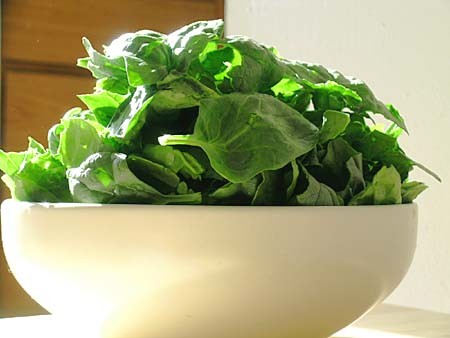
Recipe: Wilted Spinach Salad
- 10 to 12 ounces spinach, washed and torn into pieces
- ¼ cup minced red onion
- 5 to 6 radishes, thinly sliced
- 2 hard-cooked eggs, 1 chopped and 1 sliced
- 2 to 4 slices bacon
- 1 to 1 ½ tablespoons bacon drippings
- 1 ½ tablespoons sugar
- 3 tablespoons vinegar
- 1 tablespoon water
- ½ teaspoon salt
- 1/8 teaspoon pepper
Place prepared spinach in a large bowl. Add onions and radishes. Refrigerate, tightly covered. Fry or microwave bacon until crisp; remove to paper towel and set aside. In a small jar or measuring cup combine drippings with sugar, vinegar, water, salt and pepper. Refrigerate all ingredients until just before serving. When ready to serve, microwave the dressing on high for 30 to 45 seconds, or until mixture boils. Toss the chopped egg with the greens then pour the hot dressing over greens mixture; toss again lightly. Top with sliced egg and crumbled bacon.
Recipe: Spinach Lasagna
- 2 egg whites
- 26 oz of prepared spaghetti sauce
- 24 oz of ricotta cheese
- 10 oz of Lasagna noodles, cooked
- 10 oz of frozen spinach, thawed and chopped, then squeezed dry
- 2 cups of mozzarella cheese, grated, reserve ½ cup
- ¾ cup of Parmesan cheese, grated and divided, reserve 2 tablespoons
- ½ teaspoon of salt
- ½ teaspoon of black pepper
- Olive oil
Preheat oven to 350°. Prepare a 9-in. by 13-in. baking dish for lasagna. Prepare lasagna noodles as directed on the package, then rinse and drain. Combine parmesan cheese, ricotta cheeses with the egg whites, salt and pepper in a large mixing bowl. Pour ¼ cup of spaghetti sauce in the bottom of the baking dish and spread it out using a spatula. Cover the sauce with a single layer of lasagna noodles. Spread about half the cheese mixture over the noodles, and then cover with about half of the spinach and shredded mozzarella cheese. Finish this layer with half of the remaining spaghetti sauce. Add a second layer of noodles, topping with the remaining cheese mixture, spinach, and mozzarella cheese. Top with the final layer of noodles and remaining spaghetti sauce. Sprinkle the reserved Parmesan cheese over the top and bake for 30 minutes. Remove from oven and set for 10-12 minutes.
Food for Thought Understanding Lactose Intolerance
If you are lactose intolerant or if you know someone who is, here are some things that will help you to learn more about this condition:

- Our bodies produce an enzyme called lactase and when you drink a glass of milk or eat cheese, lactase helps to break down the milk sugar, or lactose, into simpler sugars that are eventually absorbed into your bloodstream. People that are lactose intolerant have a lactase deficiency.
- Many other illnesses have symptoms very comparable to lactose intolerance. It’s best to check with your doctor regarding your symptoms and he/she may suggest that you cut out dairy and denote any changes. A breath test or tests of your stool can determine whether or not you are lactose intolerant.
- Undigested lactose can cause a variety of gastrointestinal symptoms, typically within two hours of having a dairy product… including nausea, bloating, abdominal pain, flatulence and diarrhea. Although some people may have a lactase deficiency and have none of these symptoms at all.
- While a few babies are born with a lactase deficiency, most people become lactose intolerant from age 2 to 12. And even though most people become lactose intolerant during their childhood, they typically do not show signs of the intolerance until late adolescence or early adulthood.
- Almost 65% of people worldwide or nearly 30 million Americans suffer from some degree of lactose intolerance. It is more common among Asians, Africans, Hispanics, or Native Americans and less likely if your ancestors are from northern or western Europe.
- Lactose intolerance is not the same thing as a milk allergy. If you are allergic to milk, then your body is actually fighting dairy as if it were a harmful intruder in your body. Symptoms are far more severe than lactose intolerance and may include: itchy eyes, rash and wheezing. People who are allergic to milk must avoid it entirely.
- People with lactose intolerance can consume some amounts of dairy without any symptoms. Most people can drink up to a half-cup of milk without it affecting them at all.
Healthy Living Food Hacks to Help with Pesky Issues
No one ever wants to admit that their breath may not be the best smelling or that they are an insomniac… but they are both issues that many people have to deal with, among other pesky health problems.
Fortunately, there are some easy “food hacks” that will tackle bad breath and much more!
Food is your “best weapon” when it comes to helping your body deal with some of these not-so-pleasant situations.

Here are some foods that can help:
Have bad breath? Try eating some yogurt. According to experts, eating unsweetened yogurt can reduce the level of odor-causing hydrogen sulfide bacteria in your mouth. Good bacteria found in yogurt, like streptococcus thermophilus and lactobacillus bulgaricus, overpowered the hydrogen sulfide and helped lower levels by more than half – helping to eliminate the smelly mouth odor.
Can’t sleep? Try some kiwi.
Because of the high levels of antioxidants and serotonin in kiwi, many people with sleep disorders have found that eating kiwi one hour before bed will help with their insomnia. People with sleep disorders have increased levels of oxidative stress and low levels of serotonin can cause insomnia. Eating kiwi counteracts this process and can help people catch their ZZZZ’s.
Have a hard workout? Eat some ginger.
If you hit the gym pretty hard and are dealing with the after effects of a tough session, munch on some ginger. Eating just 2 grams of raw or heated ginger per day can reduce post-workout muscle soreness by 25 percent. Ginger contains anti-inflammatory compounds and oils called gingerols that contain painkilling and sedative effects in tests conducted.
Have acne? Indulge in some salmon.
Salmon is rich in omega-3 fatty acids which decreases inflammation. Studies show that inflammation is one of the underlying causes of acne and pimples.
Eating Healthy Spotlight on: Tomatoes
- Besides containing 40 percent of your daily value of vitamin C, it also contains 15 percent of your daily value of vitamin A, 8 percent of your daily value of potassium, and 7 percent of your recommended dietary allowance of iron for women and 10 percent for men.
- Lycopene, what gives tomatoes their red pigment, acts as an antioxidant, neutralizing free radicals that can damage cells in the body.
- Studies show that men who at least eat 10 servings of tomatoes a week can reduce their risk of developing prostate cancer by a whopping 45 percent.

Recipe: Tomato Casserole with Sweet Onions
- 6 medium tomatoes, peeled, cored and cut into wedges
- 1 large Vidalia onion or other sweet onion
- 1 teaspoon fresh dill, or scant ½ teaspoon dried dillweed
- 1 teaspoon fresh thyme, or scant ½ teaspoon dried leaf thyme
- Salt and pepper, to taste
- 2/3 cup fresh bread crumbs
- 3 cloves garlic, minced
- 1 cup shredded mozzarella cheese
- 3 to 4 tablespoons olive oil
Place peeled tomato wedges on paper towels to drain. Peel onions and slice into ¼-inch rings. In separate bowl combine dill, thyme, salt, pepper and bread crumbs. Layer half of the tomatoes and onions in a lightly buttered baking dish and top with half of the minced garlic. Sprinkle with half of the bread crumb and seasoning mixture, half of mozzarella cheese, and drizzle with half olive oil. Repeat layers. Bake in preheated 350 degree oven for 45 to 50 minutes, or until bubbly.
Recipe: Corn and Black Bean Salsa
- 3 to 4 small ears of corn
- 1 can (15 to 16 oz.) black beans, drained and rinsed thoroughly
- 1 large tomato, seeds removed, diced
- 1 large clove garlic, minced
- ¼ cup minced red onion
- 2 to 3 tablespoons finely minced jalapeno or poblano pepper
- Juice of one lime, about 3 tablespoons
- 3 tablespoons fresh, chopped cilantro
- Dash salt and pepper, to taste
Grill or broil corn to char slightly; let cool. Combine remaining ingredients in a bowl. Cut corn from cobs and add to the mixture. Refrigerate for at least an hour before serving time.
Great alternative to sauces, and is especially tasty on grilled fish, chicken or pork!
Enjoy a full years subscription of Healthy Revelations and discover life-changing health secrets you won't find anywhere else.
- $240 Yearly Value
- How To Lose Weight Fast
- Healthy Eating
- Stress Relief
- Disease Prevention
- Doctor Recommendations
- Seasonal Health Tips
- And More...